
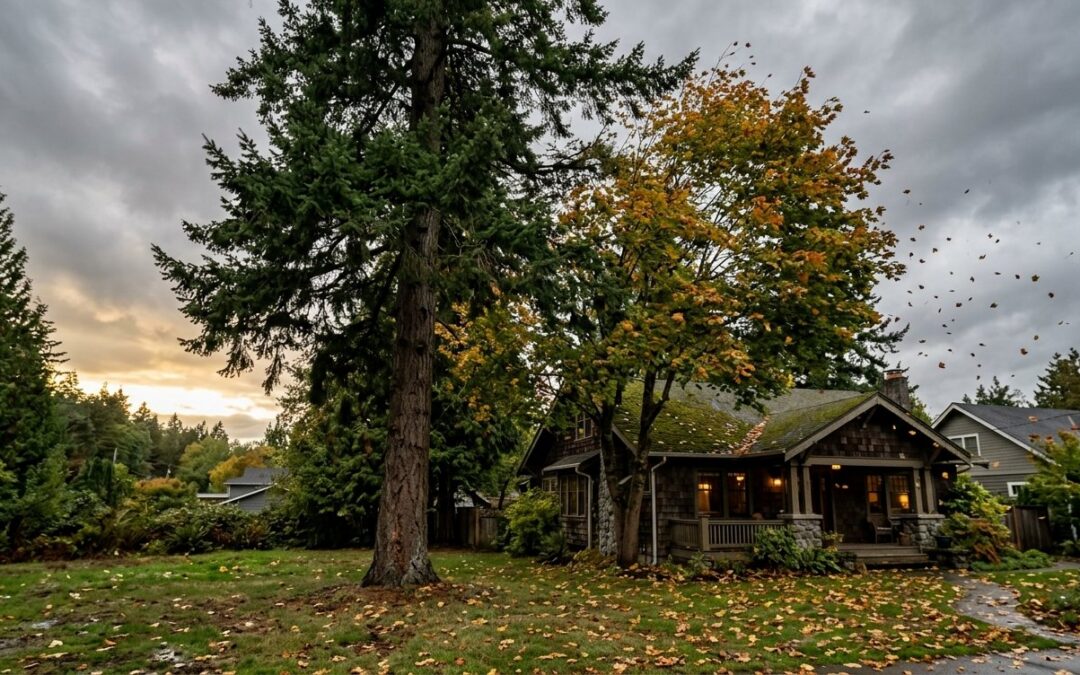
Here’s the hard part: usually somebody could have. Trees rarely fail without warning — they just fail without anyone looking. The signs were there in August, when the weather was nice and nobody was thinking about wind.
You have about six weeks before windstorm season starts. Here’s what to walk out and check.
The 6-point check
None of this requires equipment. Walk your property, look at each mature tree up close, then back up thirty feet and look at the whole thing again. Trees hide their problems at close range and show them from a distance.
1. Look at the ground before you look at the tree
Start at the base. You’re looking for soil that’s cracked, lifted, or mounded on the side opposite the way the tree leans, and for any gap opening between trunk and dirt. That’s the root plate lifting, and it is the most serious thing on this list.
A tree that’s leaned the same way for twenty years is usually fine. A tree that’s leaning more than it used to, with disturbed soil at the base, is telling you something urgent.
2. Check for mushrooms and shelf fungus
Those hard, shelf-shaped brackets growing out of the trunk or the root flare aren’t the problem — they’re the fruit of a problem that’s been working inside the wood for years. By the time you can see fungus outside, decay is established inside.
Anything fruiting at the base deserves professional eyes. That’s the part of the tree holding everything else up.
3. Look up into the crown for deadwood
Bare, grey, brittle branches up top while the lower canopy is still green is a tree losing ground from the top down. Those upper limbs are also the ones with the farthest to fall and the most to hit.
On western red cedars specifically, a dead top with healthy green lower down has become common across the Puget Sound. Researchers at WSU are still sorting out why, so be wary of anyone selling you a guaranteed cure. The question we can answer is the practical one — whether that cedar has become a safety issue or just an unattractive one.
4. Find the forks and judge the angle
Where a trunk splits into two stems, the shape of the join matters enormously. A wide, U-shaped fork is strong. A tight, V-shaped fork often has bark trapped inside the union instead of solid wood, and that’s a seam waiting for a side load. Storms provide side loads.
5. Walk the trunk looking for cracks and hangers
Vertical cracks — especially ones deep enough to slip a finger into — mean the trunk is already separating. And look up for hangers: broken limbs that never made it to the ground and are resting in the canopy. Those come down on their own schedule, no storm required.
6. Remember what’s been done near the roots
New patio, new driveway, a utility trench, regrading, a fence line dug in. If roots were cut on one side of a mature tree in the last few years, the anchoring on that side is weaker even though the canopy still looks perfect.
This is the one homeowners almost never connect, and it explains a lot of trees that fail in their first big blow after a remodel.
What to do with what you found
Not every finding means removal. That’s worth saying plainly, because plenty of people put off the inspection out of fear that a tree they love is going to get a death sentence.
Often the answer is crown reduction — bringing the canopy in so there’s less sail area for wind to push against, while keeping the tree’s health and natural shape. It’s the difference between a tree that rides out a storm and one that catches it like a spinnaker. For trees that are structurally sound but overgrown, it’s usually the right call.
Ongoing tree maintenance handles deadwood and hangers before they become projectiles. Removal is the answer when the structure itself has failed — a compromised root plate or a decayed trunk isn’t something pruning fixes.
What matters is that somebody qualified makes that call. Decay behind a conk and the true strength of a co-dominant union are not things anyone can judge from the ground, and we’d rather look than guess.
Why we care about the timing
Do this now and you have options. Schedules are open, the weather cooperates, and you can take your time deciding.
Do it in December and you’re calling every tree company in the county on the same morning as your neighbors, after the wind has already made the decision for you. Emergency work costs more, and it happens on the storm’s schedule rather than yours.
Six weeks is enough runway to get an assessment, think about it, and get the work done calmly.
If a tree does come down
Sometimes the storm wins anyway. If that happens:
- Keep everyone away from it, and treat any line it’s touching as live
- If power lines are involved, call the utility first — before anyone else
- Photograph everything before it’s moved; your insurer will want that
- Don’t start cutting. A fallen tree is loaded with tension in ways that aren’t visible, and that’s how people get hurt after the storm instead of during it
Then call us. Emergency tree service runs 24/7, and we handle storm cleanup — fallen limbs, downed trees, blocked driveways, and a look at whatever’s still standing nearby. We’ll also help with the insurance follow-up to move the claim along faster, because that paperwork is its own kind of storm damage.
A note on who should be looking
Storm risk assessment is a real discipline, not a glance from the driveway. Our team includes ISA-Certified Arborists, and one of our arborists holds the Tree Risk Assessment Qualification — the credential built specifically for judging how and whether a tree is likely to fail. You can meet the crew on our team page.
We’ve been caring for greater Seattle-Tacoma properties since 2010. Licensed, insured and bonded, WA Contractor License #SOUNDPL826DZ.
We work across King, Pierce, Snohomish, Kitsap, Island and Skagit counties:
Get It Looked At While the Weather Is Good
An inspection costs you an hour. The alternative costs considerably more, and it happens at 2 a.m. We have cared for greater Seattle–Tacoma properties since 2010 — licensed, insured and bonded, with ISA-Certified Arborists on the team.